 WhatsApp
  +919824528967
  Book A Meeeting
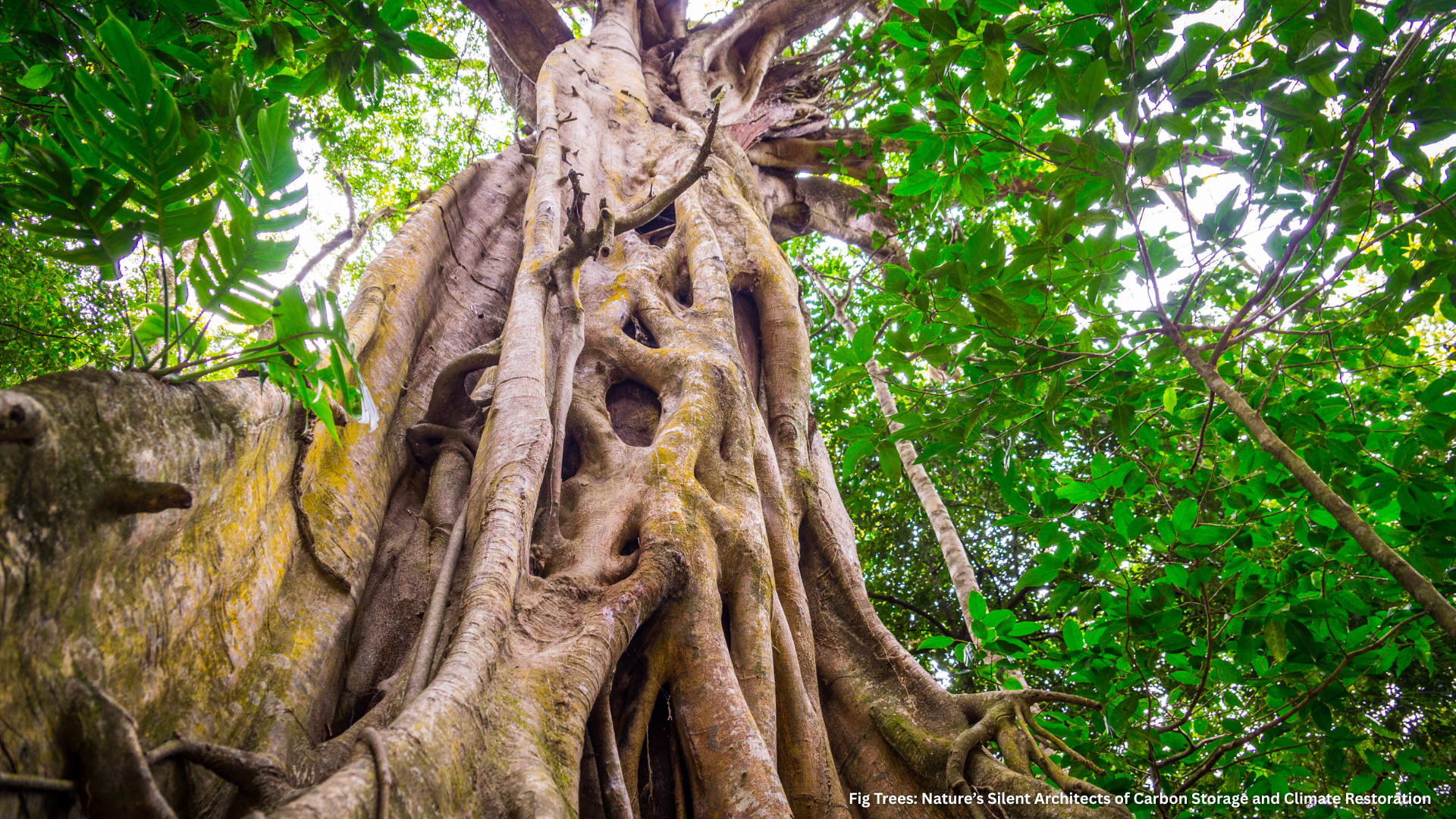




In the global race to mitigate climate change, few would imagine that the humble fig tree (Ficus spp.)—a species revered for centuries in cultural and spiritual traditions—might hold one of nature’s most powerful tools for carbon storage and ecosystem resilience.
Beyond its symbolic value, the fig tree represents an extraordinary natural climate solution, combining high biomass accumulation, soil enrichment, biodiversity support, and even the ability to lock atmospheric carbon into stone through a unique biological pathway.
At Credynova, where we integrate science, finance, and sustainability for measurable impact, we believe that fig trees embody the very principle of “profit with purpose”—delivering carbon offsets, biodiversity restoration, and social value through one living system.
The Science of Carbon Capture: How Fig Trees Store Atmospheric Carbon
Fig trees grow rapidly and build dense wood, making them highly efficient carbon absorbers.
Studies show that:
- A single mature Ficus benghalensis (banyan) can store up to 1.76 tons of carbon (~6.5 tons CO₂ equivalent).
- Urban park studies in India found Ficus benjamina sequestering 11.1 tons of carbon per year across clusters of mature trees—comparable or superior to eucalyptus plantations.
- Soils beneath fig trees hold 2–3 times more organic carbon than control sites, due to rich litterfall and microbial activity.
But the real marvel lies in the Oxalate-Carbonate Pathway (OCP)—a biochemical process through which figs convert CO₂ into calcium carbonate (essentially limestone) within their roots and surrounding soil. This process ensures a portion of the carbon remains permanently locked away for centuries, even after the tree dies.
In short, fig trees don’t just capture carbon—they store it forever.
Beyond Carbon: Fig Trees as Catalysts of Life
Figs are ecological keystones. Their fruit feeds more than 1,300 species of birds and mammals, often during dry seasons when other food sources vanish. This year-round productivity sustains wildlife and drives natural forest regeneration.
Their root systems stabilize soils against erosion and landslides, while their canopies regulate microclimates—lowering heat stress and aiding local rainfall. In urban settings, mature figs have been shown to improve air quality, water infiltration, and flood resilience.
In tropical reforestation, planting as little as 10% fig saplings among native species can jumpstart ecological succession, attract pollinators, and multiply biodiversity far beyond monoculture plantations.
Fig Trees in Agroforestry and Reforestation
From drylands in Iran to tropical forests in Thailand, fig trees are proving to be powerful tools for land restoration:
- In semi-arid soils, Ficus carica improved soil fertility and doubled soil carbon compared to eucalyptus.
- In Thailand’s reforestation efforts, fig trees seeded via drones have accelerated forest recovery by attracting fruit-eating birds that disperse other seeds.
- In Kenya, Ficus wakefieldii demonstrated the conversion of CO₂ into limestone, turning tree plantations into long-term carbon vaults.
Fig trees thrive where others fail—in poor, saline, or degraded soils—making them ideal for restoring marginal lands and ensuring social and ecological co-benefits.
Why Fig Trees Outperform Typical Reforestation Species
| Parameter | Fig Trees (Ficus spp.) | Eucalyptus / Pine |
| Carbon Storage | High, with permanent carbonate formation | High but temporary (harvested biomass) |
| Soil Health | Increases organic carbon & humus | Often depletes or acidifies soil |
| Biodiversity | Supports 1000+ animal species | Low habitat value |
| Water Use | Moderate | High (can deplete groundwater) |
| Longevity | Centuries | 10–25 years (timber cycle) |
| Carbon Permanence | Organic + Inorganic (mineral) | Only organic |
Unlike monoculture plantations, fig trees deliver climate resilience with ecological integrity. Their carbon remains locked in both biomass and mineral form, while their fruit and shade support communities and wildlife alike.
Figs in Action
Brazil: Old-growth Ficus in Belo Horizonte urban parks improved soil carbon and flood control—integrating climate mitigation with urban resilience.
Iran: Fig plantations doubled soil carbon vs. eucalyptus, proving suitability for dryland carbon projects.
Kenya & India: Research revealed figs convert CO₂ into stone—demonstrating true biological carbon capture and storage (bio-CCS) potential.
The Credynova Perspective: Integrating Figs into Climate Finance
Credynova is developing MRV-linked carbon methodologies that recognize multi-benefit tree species like figs.
Our framework evaluates:
- Organic carbon accumulation (biomass & soil)
- Inorganic carbon formation (OCP-based mineral sequestration)
- Biodiversity and ecosystem co-benefits
- Socio-economic impacts through agroforestry livelihoods
By integrating these dimensions, fig trees can generate high-integrity carbon and biodiversity credits, aligning with emerging global standards such as Verra, Gold Standard, and ISO 14064.
Conclusion: Planting Figs for a Cooler, Kinder Planet
In a world seeking scalable, science-based, and equitable climate solutions, fig trees remind us that nature often holds the answers we overlook.
They sequester carbon fast.
They store it forever.
They feed the forest and the farmer.
At Credynova, we see fig trees not merely as plants—but as living climate technologies rooted in resilience, regeneration, and hope.
Let’s plant the future—one fig tree at a time.
