 WhatsApp
  +919824528967
  Book A Meeeting


Microscopic Powerhouses Behind the Planet’s Climate
While often overlooked, phytoplankton — the microscopic, photosynthetic organisms floating in our oceans — have a profound impact on Earth’s climate. These tiny marine organisms not only form the base of the oceanic food web and absorb vast quantities of carbon dioxide (CO₂), but also participate in an elegant, natural mechanism that helps cool the planet, increase cloud formation, and potentially influence rainfall patterns, even across adjacent desert regions.
Recent research highlights how phytoplankton-derived sulfur compounds contribute to cloud condensation nuclei (CCN), brightening clouds and reflecting sunlight. In this article, we explore the powerful role of phytoplankton in regulating climate and hydrological cycles, their biochemical pathways, the science behind marine cloud formation, and how these processes could support global climate resilience and land restoration.
The Biochemical Link – From Phytoplankton to the Sky
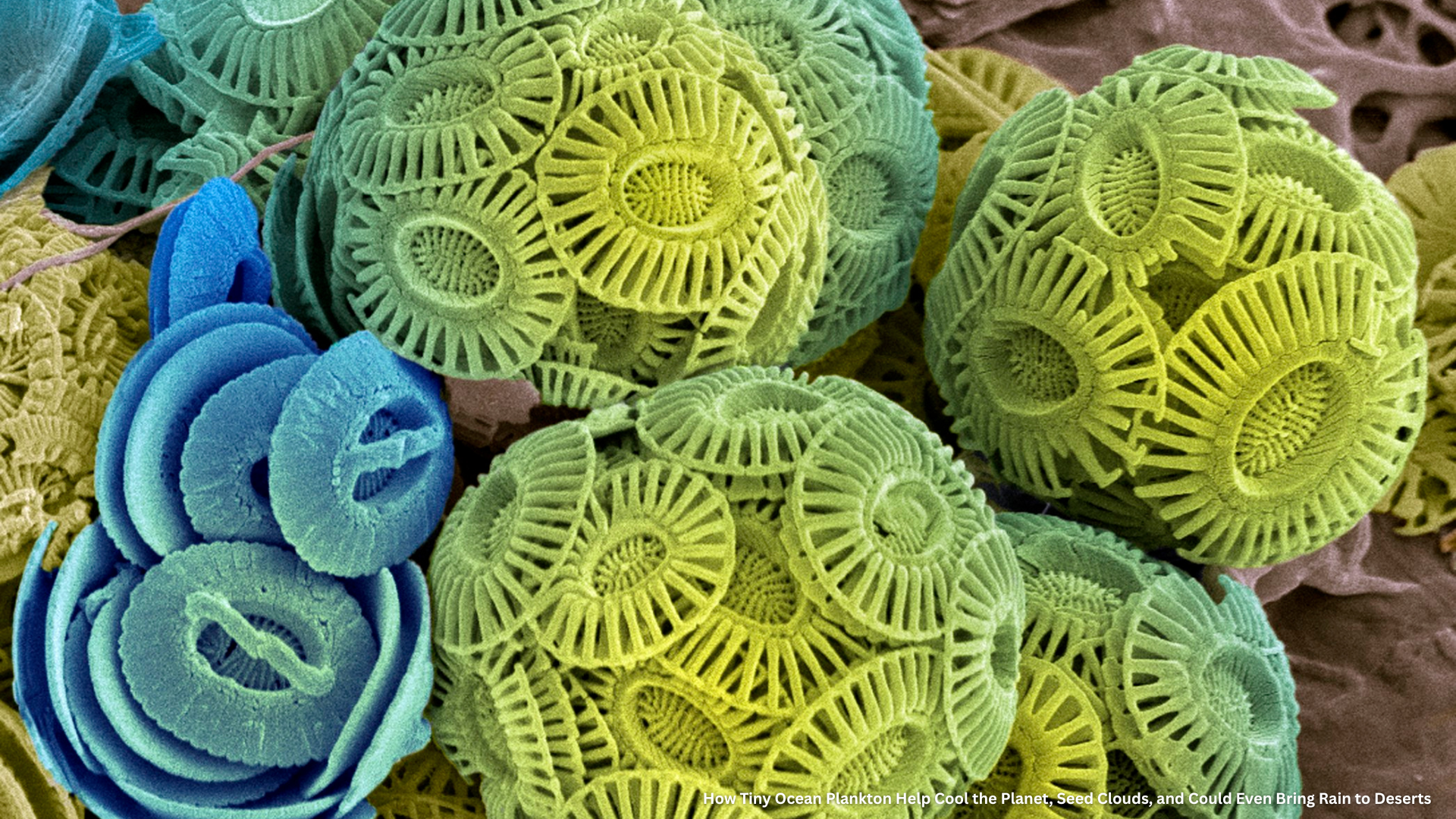
Many phytoplankton species, such as Emiliania huxleyi, produce dimethylsulfoniopropionate (DMSP) — an organosulfur compound that acts as an osmoprotectant. Through bacterial enzymatic activity, DMSP is converted into dimethyl sulfide (DMS), a volatile gas that escapes from ocean water into the atmosphere.
Once airborne, DMS undergoes oxidation to form sulfur dioxide (SO₂) and eventually sulfate aerosols (SO₄²⁻). These fine particles act as cloud condensation nuclei (CCN) — microscopic seeds that attract water vapor to form cloud droplets. Over vast stretches of ocean, DMS is one of the primary sources of natural CCN, linking marine biology directly to atmospheric processes.
DMS-Cloud Feedback Loop & Climate Cooling
The CLAW hypothesis (Charlson, Lovelock, Andreae, and Warren) describes this self-regulating feedback mechanism:
- Sunlight and warmth stimulate phytoplankton blooms.
- Blooms release more DMS into the atmosphere.
- DMS oxidizes into sulfate aerosols.
- Aerosols seed cloud formation.
- Clouds become brighter and more extensive, reflecting more solar radiation.
- Surface cooling occurs, which can stabilize or reduce warming.
This negative feedback loop creates a form of natural climate regulation. Satellite data confirms that during periods of peak phytoplankton activity, marine clouds become denser and more reflective, leading to regional surface cooling.
From Clouds to Rain — Can Plankton Bring Precipitation?
More cloud condensation nuclei (CCN) not only increase cloud brightness but also affect rainfall patterns:
- In shallow marine stratocumulus clouds, increased CCN can suppress light drizzle, as cloud droplets remain small and do not coalesce easily.
- In deeper convective clouds, aerosol loading can invigorate updrafts, increasing the potential for intense rainfall events.
This means plankton-induced cloud changes may redistribute rainfall, sometimes benefiting coastal or adjacent arid regions if moisture-laden clouds drift inland. For instance:
- The Namib Desert receives moisture from fogs fueled by plankton-rich Benguela Current offshore.
- Dust from African deserts fertilizes the Atlantic, stimulating blooms that may enhance cloud formation, influencing Sahel rainfall cycles.
Global Evidence and Case Studies
Southern Ocean Observations: Phytoplankton blooms have been shown to double cloud droplet concentrations, increasing reflected solar radiation by up to 10 W/m², creating measurable regional cooling.
Saharan Dust & East Africa: In 2019, dust from Kalahari and Namib deserts fueled a bloom off East Africa, linking drought-driven dust events to enhanced marine biological activity and potential atmospheric impacts.
Model Simulations: Climate models show that artificial increases in DMS emissions could cool global temperatures significantly, but also risk reducing rainfall in vulnerable regions like the Horn of Africa and South Asia.
Plankton, Deserts, and Climate Restoration
Although the idea of using phytoplankton to reverse desertification is speculative, the potential is fascinating:
- More clouds = lower surface temperatures, reducing evaporation and water stress.
- Extended cloud cover could alter regional precipitation cycles, delivering moisture where it’s desperately needed.
- Healthy oceans and dust-driven fertilization might offer natural interventions to stabilize drylands without direct human manipulation.
However, caution is warranted: indiscriminate geoengineering (e.g. ocean iron fertilization) could lead to unintended climate and ecological consequences, including harmful algal blooms or disrupted monsoons.
DMS-Cloud-Rainfall Cycle
| Step | Process | Climate/Hydrological Impact |
| Phytoplankton Bloom | Rapid growth produces DMSP, converted to DMS | Biological carbon uptake; gas precursor released |
| DMS Emission | DMS volatilizes into the atmosphere | Source of cloud seeding agents |
| Atmospheric Oxidation | DMS → SO₂ → SO₄²⁻ (sulfate aerosols) | Formation of CCN |
| Cloud Formation | Sulfate aerosols seed droplet formation | Increases cloud cover and brightness |
| Radiative Cooling | Brighter clouds reflect more solar energy | Local and regional surface cooling |
| Rainfall Redistribution | More/less rain depending on cloud type and dynamics | Possible relief or worsening of aridity |
Conclusion: Climate Allies in the Deep
Phytoplankton demonstrate how Earth’s smallest life forms exert planetary-scale influence. From the ocean surface to the upper atmosphere, these organisms:
- Regulate CO₂ and slow global warming.
- Form clouds that cool the Earth.
- Potentially influence rainfall over continents.
Their role underscores the need to protect marine ecosystems, preserve nutrient cycles, and study Earth’s natural feedback systems. At Credynova, we believe understanding and aligning with such processes is critical for designing sustainable climate solutions and preparing for a resilient planetary future.
“The invisible breath of ocean life may hold the key to a cooler, greener world.”
