 WhatsApp
  +919824528967
  Book A Meeeting
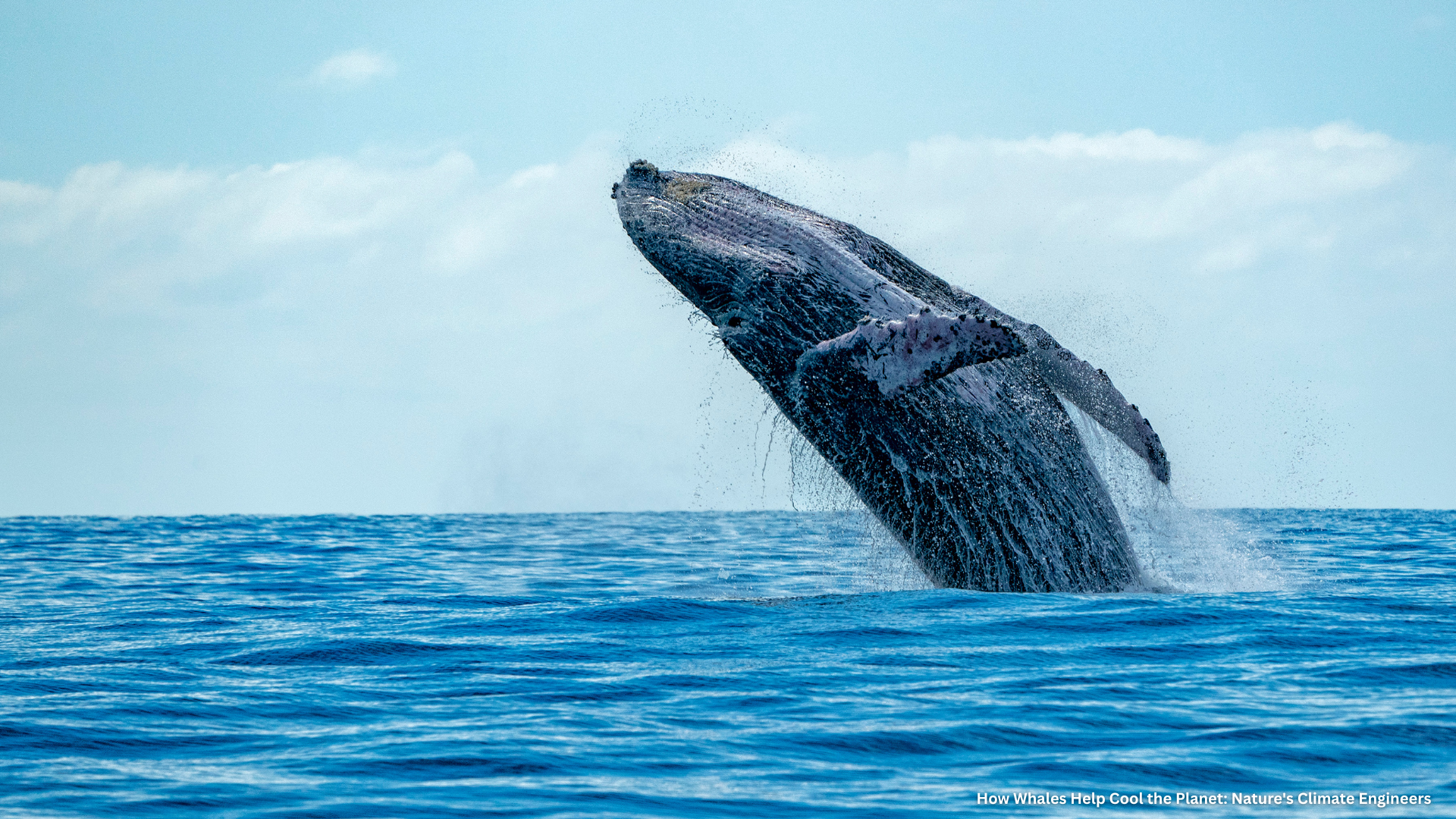



When we think of natural solutions to climate change, forests and plants often come to mind. But in the vast blue depths of our oceans, whales are quietly working as unsung heroes. These majestic creatures do more than inspire awe—they act as powerful agents of carbon storage and marine ecosystem health. By restoring whale populations, we can leverage a natural climate technology millions of years in the making.
Whales as Living Carbon Sinks
Great whales accumulate immense quantities of carbon in their bodies over decades. On average, each whale sequesters about 33 tons of CO₂ through the proteins, fats, and other tissues in their biomass. When whales die, their carcasses often sink to the ocean floor—a process known as a “whale fall”—effectively locking away that carbon in deep-sea sediments for centuries. This is nature’s version of long-term carbon capture and storage.
Due to industrial whaling, global whale populations declined by over 70% in the last two centuries. This loss has not only impacted biodiversity but has also robbed the oceans of a significant carbon reservoir. Rebuilding whale populations is equivalent to restoring a lost climate-regulating system.
The Whale Pump: Fertilizing the Ocean’s Forests
Whales also fertilize the ocean through what’s called the “whale pump.” As whales feed at depth and return to the surface to breathe, they release nutrient-rich waste containing iron and nitrogen. These nutrients are critical for the growth of phytoplankton—microscopic algae that absorb vast amounts of CO₂ during photosynthesis.
Phytoplankton account for roughly 40% of global carbon uptake, fixing more carbon annually than all the world’s forests combined. By enhancing phytoplankton growth, whales create a multiplier effect in carbon sequestration. Even a 1% increase in phytoplankton productivity due to recovering whale populations could sequester as much CO₂ as 2 billion mature trees each year.
The Climate Case for Whale Recovery
Restoring whale populations to pre-whaling levels (from ~1.3 million to ~4-5 million) could sequester an additional 1.7 billion tons of CO₂ annually. That’s equivalent to the emissions of a mid-sized industrialized nation. Moreover, the economic value of a whale’s ecosystem services (including carbon capture, ecotourism, and fisheries enhancement) is estimated at over $2 million per whale.
This makes whale conservation not just a moral or ecological issue, but a sound climate and economic strategy.
Marine Life Beyond Whales
Whales aren’t alone in this carbon story. Other marine life like large fish, seabirds, and even sea otters play supporting roles in oceanic carbon cycling:
- Large fish store carbon in their biomass and contribute to deep-sea sequestration when they die naturally.
- Seabirds transport nutrients between ocean and land, enhancing coastal and open-ocean productivity.
- Sea otters maintain healthy kelp forests by controlling sea urchins, allowing kelp to sequester more CO₂.
Protecting these animals helps maintain a resilient and carbon-efficient marine ecosystem.
Scaling the Solution
To globally scale whale-powered climate benefits, we need:
- Stronger enforcement against commercial whaling
- Reductions in ship strikes and fishing gear entanglement
- Marine Protected Areas in key whale habitats
- Integration of marine life into climate policy and finance
International organizations like the IMF and IWC are already highlighting the role of cetaceans in climate mitigation. By valuing whales as carbon assets, countries and companies could invest in their protection as part of climate strategies.
Conclusion
Whales are more than ocean giants; they are nature’s climate engineers. Their presence strengthens carbon capture, supports marine biodiversity, and brings cascading benefits to the entire planet. Restoring whale populations is a powerful and poetic climate solution—one that reminds us of the deep connections between life and the atmosphere.
At Credynova, we believe in harnessing the wisdom of nature to restore planetary balance. Protecting whales and marine life isn’t just about saving species—it’s about healing the climate from the sea up.
